By Linda Fisher Thornton With leadership responsibility comes a certain amount of influence. We can impact how people think. We can advise them on the choices they make and invite them to follow our lead. “Leadership is not about titles,…
Category: Ethical Leader
The Messages Micromanagement Sends

By Linda Fisher Thornton Micromanaging is not just another "leadership style." It harms people. When leaders micromanage, they send many negative messages to employees. Take a look at this list of more than 20 negative unspoken messages micromanagement sends to employees. Can you afford to let it happen in your organization?
Systems Thinking: Untangling Increasing Pollen Allergies

By Linda Fisher Thornton
Large-scale problems usually have more than one cause. When we look for solutions, we need to investigate many different possible variables. Today, I'll look at multiple causes of increasing allergies to pollen. This issue is of particular concern to me since I live in one of the Top 10 Most Challenging Places to Live With Spring Allergies (Asthma and Allergy Foundation of America).
WRIR “Inspire Indeed” Interview

By Linda Fisher Thornton Christa Motley, host of Inspire Indeed at WRIR radio, invited me to the station to talk about the journey to writing my book 7 Lenses and how it is helping people who want to understand ethical…
Rights, Responsibilities and Freedom

By Linda Fisher Thornton
While some people think of rights, responsibilities and freedom separately, in a compartmentalized way, I believe they cannot be separated. According to John Courtney Murray, freedom was always intended to be grounded in ethical values.
Respect, Interpreted Part 3
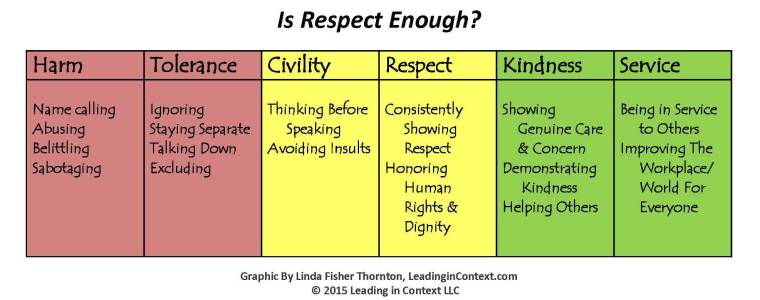
By Linda Fisher Thornton
What exactly does respect look like? It's a question that is difficult to answer, but we need an answer if we are going to be able to help our leadership teams learn how to show it, recognize it, and expect it from others. This week I'm sharing some work I've done that may help.
The Gut-Brain Axis (Ethical Questions)

By Linda Fisher Thornton
I am a long-time advocate of systems thinking. It has risen in importance as an increasing number of our greatest human challenges can't we understood or resolved without it.
Today, I'm taking a look at new findings on the human microbiome, which is known to impact the brain in important ways. You may have already seen the recent news about advances in our understanding of the Gut-Brain Axis.
19 Leadership Trend Reports for 2019

By Linda Fisher Thornton One of the challenges of responsible leadership is staying on top of fast-moving trends. This week, I'm making that process a little easier for you by sharing 19 interesting leadership trend reports. Get ready to read…
Unethical Leadership: Selective Respect

By Linda Fisher Thornton
We've seen selective respect too often. Beyond harming the people who are disrespected, it also destroys trust, and leads to chaotic environments and fear-based cultures. Even though we've all seen selective respect in action, we may not have had the vocabulary to describe why it's wrong (beyond calling it mean or inappropriate). This week I'm digging in to those details.
The Complexity of Ethical Thinking and Decision Making (Part 6)

By Linda Fisher Thornton
This series has explored 5 important spheres of Ethical Thinking and Decision Making.
This week I'm summing it up in a checklist that will help you apply all 5 to your daily choices. When you are making a key decision, run it through the checklist to be sure you have considered all 5 important dimensions.
The Complexity of Ethical Thinking and Decision Making (Part 5)

By Linda Fisher Thornton While change is a constant reality, it doesn't always factor into leadership thinking. In Part 1 and Part 2 of this series, I explored the Depth of our thinking, and the importance of understanding Context. In Part 3…
Read More The Complexity of Ethical Thinking and Decision Making (Part 5)
The Complexity of Ethical Thinking and Decision Making (Part 4)

By Linda Fisher Thornton
Who we include in our ethical thinking, and how broadly we consider our responsibility to others are important elements of ethical leadership. In Part 1 of this series, I explored the Depth of our thinking, and in Part 2, I broke down issues related to understanding Context. In Part 3, I looked at Complexity. In Part 4, we'll dig into the importance of Inclusion.
The Complexity of Ethical Thinking and Decision Making (Part 3)

Embracing Complexity is Part of Leadership
Complexity has become a way of life. To make ethical decisions, we must embrace it and incorporate it into our thinking process. That means digging in to issues until we understand their multiple dimensions, connections and contradictions. It means being intentional about decision making and avoiding making snap judgments.
The Complexity of Ethical Thinking and Decision Making (Part 2)

By Linda Fisher Thornton
In Part 1 of this series I looked at the importance of Deep Thinking. In Part 2, we'll be considering the Context. No matter how much effort it takes to understand the context (whether we like it or not) we can't expect to make an ethical decision without it.
Understanding the Context
Without seeing the context - a broad and sweeping view of the issues we are discussing or trying to resolve - we are describing or trying to solve a SUBSET of the real issue. To use ethical thinking and decision-making, we must always remind ourselves that the SUBSET is not the whole.
The Complexity of Ethical Thinking and Decision Making (Part 1)
By Linda Fisher Thornton
When Thinking is Starved For Context and Complexity
Think about how easy it is to start using shallow breathing without being aware that we're doing it. This can happen when we're stressed or anxious, and it can impact our well-being. We may be unaware that we are using shallow breathing until someone notices we're turning pale and tells us to BREATHE.
When we use shallow thinking, that similarly impacts the "well-being" of our decision making, leading us to false conclusions and ethically problematic decisions. It's almost as if when we use shallow thinking, our decision making is getting less oxygen. We can medically treat people who are having trouble breathing. But what do we do about thinking that is starved for context and complexity?
 Leading in Context