By Linda Fisher Thornton Workplace issues are complex and opinions vary about the right thing to do in challenging situations. This complexity and uncertainty combine to create a "murky uncertainty" that may keep people from giving us their best, most ethical performance.
Tag: 7 Lenses
5 Reports Say Business Ethics is Improving
By Linda Fisher Thornton What do Deloitte, Strategy & PwC, Dow Jones, The Ethics Resource Center and LRN have to say about trends in business ethics? Get ready for some good news:
Building Trust: What to Weed Out
By Linda Fisher Thornton I was weeding in the garden this week, and I discovered two new weeds that were taller than I was. I started thinking about how quickly things can get away from us, in the garden and in our organizations. There are things we must do to build a high trust workplace. But there are equally important things that we must prevent or weed out for trust to flourish.
Ethics Isn’t Finite: It’s Evolving
By Linda Fisher Thornton As we strive to build ethical organizations, we must remember that our target is moving. As the world changes, ethical expectations change. It would be easier to develop ethical leaders and build ethical organizations if ethics were a fixed destination. A point on the map. A line in the sand. But it's just not that simple. Ethical expectations are evolving.
Ethics Isn’t “Out There”: It’s Us And Our Choices
By Linda Fisher Thornton Much attention is paid to the tactics of ethics - the ethics codes, compliance plans and such. We can easily begin to think that ethics is something we can see and touch. Something finite. Something written in stone. Something outside of ourselves. But that's not where ethics lives.
The Trouble With Oversimplified Conversations
By Linda Fisher Thornton Sometimes in the rush to make a quick leadership decision, we end up "dumbing down" an issue to speed up the process. "Dumbing down" an issue may make the decision easier to make, but it may also lead us to make choices without considering current information, trends or context. Decisions made that way can cause problems.
250th Blog Post: Beyond the Comfort Zone
By Linda Fisher Thornton In the 200th Leading in Context Blog Post, I wrote about Learning at the Speed of Life. To celebrate the 250th post, I want to reflect on what it's been like to work every day in the stretch beyond the comfort zone.
Can a Toxic Leader Be Ethical? Yes and No.

"Can someone who uses toxic leadership still be an ethical leader?"The answer to this important question is "yes and no."
5 Leadership Development Priorities

By Linda Fisher Thornton The recent post "It's Not About Us" was the most popular post of all time on the Leading in Context Blog. It described how our understanding of leadership has moved beyond a focus on the leader to a focus on creating shared value for others.
Ethics is Contagious
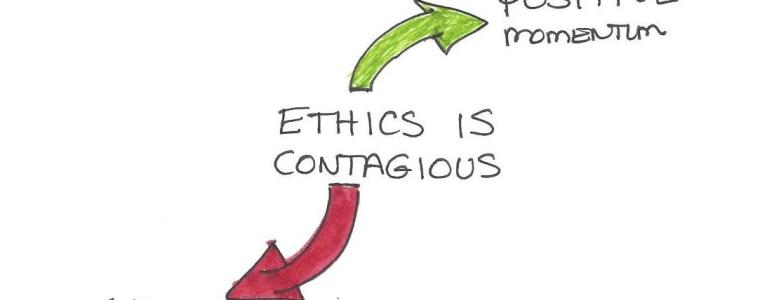
By Linda Fisher Thornton I must admit that I can't take the credit for coming up with the catchy title of this post. A group of attendees at a recent keynote I delivered came up with it as a way to describe what they had learned. And it makes perfect sense. Ethics is catching, and leaders set the tone for the ethics of the organization. What would happen if everyone in the organization followed our lead? Would the organization be more or less ethical? What kind of ethics are people catching as they work in our organization?
In Conversation About Ethics
By Linda Fisher Thornton This week Realizing Leadership: Everyday Leaders Changing Our World published a cover story interview with Laurie Wilhelm. We talked about what ethical leadership really means, how ethics and trust are related, and how leaders can learn to be more ethical from wherever they are.
What is the Ultimate Goal of Leadership?
By Linda Fisher Thornton What is the ultimate goal of leadership? This is an interesting question that seems simple enough at first, and then begins to get tricky as we think more about it. The tricky part is that we can't answer it in one simple statement. Is it to provide direction and show the way? Is it to respect and serve? Is it to support others and remove obstacles? Is it to teach and mentor? Is it to help bring out the best in those we lead as we work toward a common purpose? Of course, leadership is about all of those things and more. So what is its purpose? Here are four very different ways of thinking about the purpose of leadership.
Success From the Field Interview – Balancing Ethics and Profits
By Linda Fisher Thornton This week Will Eisenbrandt posted our interview about ethical leadership at NetworkedWealth.com. This Success From the Field Podcast with Linda Fisher Thornton is a great overview of the 7 Lenses™ of Ethical Responsibility. In the interview he asks me some questions about how to balance ethical values in day-to-day decisions - for example, balancing profits with concern for the planet.
12 Favorite Blog Posts of 2013
Annual favorites - the posts that readers enjoyed and shared and that I think best convey an important message about how to Unleash the Positive Power of Ethical Leadership™ in ourselves and our organizations.
Understanding (and Preventing) Ethical Leadership Failures
By Linda Fisher Thornton Understanding What Causes Ethical Leadership Failures Ethical leadership failures can be caused by different types of problems that may compound. Some of these problems are individual and others may be embedded in the organizational culture.
 Leading in Context